
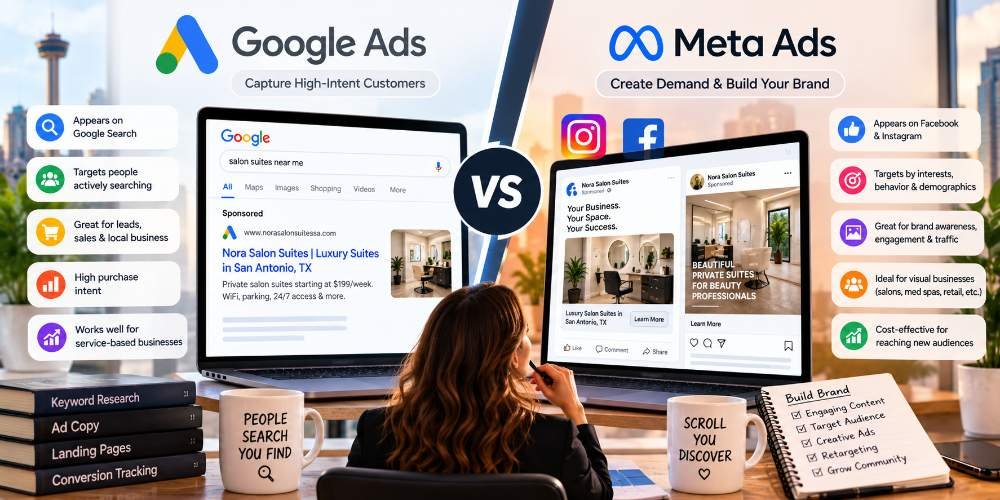
If you’re ready to spend money on online advertising, two names come up first: Google Ads and Meta Ads (Facebook and Instagram). Both can bring in customers, and both can burn through a budget with little to show for it. The question “which is better?” has no universal answer, because they work in fundamentally different ways and suit different goals.
This guide compares them head to head, explains when each tends to work best, and shows how many businesses use them together.
The Core Difference: Intent vs. Interruption
The simplest way to understand the two is this:
- Google Ads captures existing demand. Search ads appear when someone types a query, such as “emergency plumber near me.” The person is already looking, so intent is high.
- Meta Ads creates and nurtures demand. Ads appear while people scroll Facebook and Instagram. They weren’t searching, but you can reach them based on interests, behavior, and demographics and spark interest.
That difference shapes everything else: who sees your ad, what the ad needs to do, and how quickly people act.
How Google Ads Works
Google offers several ad formats, but search ads are the best known. You choose keywords, write ads, and bid for placement when people search those terms. You typically pay when someone clicks. Google also offers other formats, such as display, video on YouTube, and shopping ads for products, which reach people in other contexts.
Strengths
- Reaches people at the moment they’re actively looking
- Strong for urgent, high-intent services
- Clear connection between a search and a lead
- Phone call and local options for service businesses
Limitations
- Competitive terms can be expensive
- Only reaches people who search for what you offer
- Needs strong landing pages and careful keyword management
Learn more in our guide to choosing a Google Ads agency in San Antonio.
How Meta Ads Works
Meta Ads runs across Facebook, Instagram, and related placements. You choose an objective, such as leads, messages, traffic, or sales, define an audience, and show image, video, or carousel ads. Because it’s visual and interest-driven, creative quality matters a great deal.
Strengths
- Reaches people before they start searching
- Strong visual storytelling, especially for products, services, and local experiences
- Detailed audience targeting and options to reach past visitors
- Works well for awareness, offers, events, and promotions
Limitations
- People weren’t looking, so intent is usually lower than search
- Results depend heavily on creative and fresh content
- Tracking and attribution can be less precise, so proper setup matters
Learn more in our guide to choosing a Meta ads agency in San Antonio.
Side-by-Side Comparison
- Customer mindset — Google: actively searching. Meta: browsing and open to discovery.
- Best for — Google: capturing demand. Meta: generating demand and staying visible.
- Creative needs — Google search: strong copy and keywords. Meta: strong visuals and video.
- Speed to leads — Google: often faster for high-intent services. Meta: can be quick, but depends on offer and creative.
- Targeting — Google: by search terms, location, and more. Meta: by audience interests, behavior, location, and demographics.
- Learning curve — Both take expertise to run profitably.
Which Platform Fits Which Business?
Google Ads Often Fits When:
- Customers search for your service when they need it, such as plumbing, AC repair, locksmiths, or towing
- You sell something people actively look for, such as legal help or dental care
- You want leads quickly and can handle the volume
Meta Ads Often Fits When:
- Your offer is visual or lifestyle-driven, such as restaurants, salons, fitness studios, boutiques, and events
- People don’t usually search for you by name yet, and you need to build awareness
- You want to promote specific offers, launches, or seasonal campaigns
Examples by Business Type
- Home services and auto repair — often lead with Google for urgent searches. See home services and auto repair.
- Restaurants, salons, and fitness studios — often lean on Meta for visual promotion, with local search for people ready to book. See restaurants, salons, and fitness studios.
- Medical and dental practices — may use both, with attention to each platform’s healthcare ad policies. See medical and dental.
- Real estate and professional services — often mix both, with extra care around advertising rules for certain categories.
Policies and Restricted Categories
Both platforms have advertising policies, and some categories, such as certain health, financial, housing, and employment ads, face extra restrictions or special requirements. Read the current policies for your industry before launching, since violations can lead to disapproved ads or account problems.
Using Google and Meta Together
For many businesses, the best answer isn’t either/or. The platforms complement each other across the customer journey:
- Meta introduces your business to people who may need you but haven’t searched yet.
- Retargeting keeps you visible to those who visited your website.
- Google captures the search when they later look for what you offer.
- Email and follow-up convert and retain the leads that come in.
This kind of full-funnel approach often performs better than putting all the budget in one place, though it requires budget and capacity to do well. If you’re just starting with a limited budget, it’s usually smarter to do one platform properly than two poorly.
How to Decide Where to Start
- Think about how customers find you today — do they search, or do they discover you?
- Consider urgency — urgent needs lean toward search; impulse or lifestyle purchases lean toward social.
- Look at your creative resources — Meta needs a steady supply of good visuals.
- Check your budget — competitive search terms need enough budget to compete.
- Check your website and follow-up — both platforms need a strong landing page and fast lead response. See our guide to landing page best practices.
- Start small, measure, and adjust — test before scaling.
Measuring Results on Each Platform
Track what matters: leads, calls, bookings, cost per lead, and ultimately customers and revenue. Each platform reports its own numbers, which rarely match perfectly, so use analytics and your CRM as the source of truth. See our guides to measuring digital marketing ROI and digital marketing tools and techniques.
Common Mistakes When Choosing Between the Two
- Picking a platform because it’s popular, not because it fits how your customers buy
- Expecting Meta leads to behave like Google leads, since intent differs
- Sending traffic from either platform to a weak or slow website
- Spreading a small budget across both platforms and doing neither well
- Skipping conversion tracking, then guessing what works
- Using stale creative on Meta or generic keywords on Google
- Ignoring ad policies for regulated industries
How Sila Creations Helps San Antonio Businesses Choose and Run Paid Ads
At Sila Creations, we don’t push one platform. We look at how your customers actually buy, your budget, and your goals, then recommend where to invest, set up tracking, and manage campaigns so you can see what each dollar returns. For a wider look at how paid media fits with search, content, and follow-up, see our guides to building a digital marketing plan and working with a digital marketing agency in San Antonio.
Not sure where to put your ad budget? Contact Sila Creations today.
Frequently Asked Questions
Is Google Ads or Meta Ads cheaper?
It depends on your industry, location, competition, and goals. Costs vary widely, so compare cost per lead and cost per customer rather than the price of a click.
Which platform gets leads faster?
Google search ads often produce leads quickly for high-intent services because people are already looking. Meta can also generate leads quickly with a strong offer and good creative, but intent is usually lower.
Can a small business afford to use both?
It depends on the budget. With limited funds, it’s usually better to do one platform well first, then add the other once you have tracking and results to build on.
Do I need a website to run Google or Meta ads?
You need somewhere to send people, and a fast, focused landing page makes ads much more effective. Some campaigns can use calls or messages instead, but a strong website generally improves results.
Which is better for local businesses?
Both can work. Google tends to capture people searching for local services, while Meta can promote offers and build awareness in your area. The right choice depends on how your customers look for you.
How long should I run ads before judging results?
Allow enough time and data for the platforms to learn and for you to see meaningful numbers, often several weeks, while tracking leads and customers rather than only clicks.